

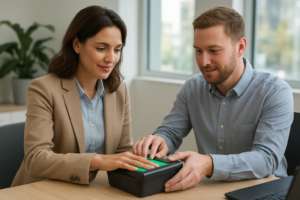
If you are applying for a salesperson or broker credential, completing your California real estate license Live Scan correctly is one of the most important steps in the licensing process. The California Department of Real Estate (DRE) requires fingerprint-based background checks for most applicants, and those prints are submitted electronically through the California Department of Justice (DOJ), with an FBI check also commonly included when required by the requesting agency. For applicants in Los Angeles, understanding when to get fingerprinted, what form to use, what fees to expect, and how to avoid common mistakes can save days or even weeks of processing time.
This guide explains how the Live Scan process works for California real estate licensing, who needs it, what happens after your appointment, and how to make the process as smooth as possible if you are applying from Los Angeles or anywhere in California. While procedures and fees can change, the practical steps below reflect the standard process most DRE applicants follow. Always confirm current instructions directly with the DRE and the official Live Scan form provided for your application.
What Is a California Real Estate License Live Scan?
A California real estate license Live Scan is an electronic fingerprint submission used to conduct a criminal history background check for real estate license applicants. Instead of using ink cards, a Live Scan operator captures your fingerprints digitally and transmits them securely to the California DOJ. Depending on the agency request, the fingerprints may also be checked through the FBI database.
For real estate licensing, the requesting agency is the California Department of Real Estate (DRE). The DRE uses fingerprint results as part of its review of salesperson and broker applications. This is separate from your exam qualification, education, or experience requirements. In other words, even if you pass the exam or meet educational prerequisites, your license cannot move forward normally until fingerprint requirements are satisfied.
Live Scan is widely used by many California licensing and regulatory agencies, including the Board of Registered Nursing (BRN), State Bar of California, Medical Board of California, California Commission on Teacher Credentialing (CTC), California Department of Social Services/Community Care Licensing Division (CDSS/CCLD), Emergency Medical Services Authority (EMSA), Bureau of Security and Investigative Services (BSIS), California Department of Insurance (CDI), Contractors State License Board (CSLB), and the California Secretary of State. Each agency has its own form and routing information, which is why using the correct DRE form matters.
Who Needs a California Real Estate License Live Scan?
Most individuals applying for a California real estate license should expect to complete Live Scan fingerprinting. This commonly includes:
- First-time real estate salesperson applicants
- First-time real estate broker applicants
- Applicants who are submitting fingerprints after exam eligibility
- Applicants who have been instructed by the DRE to complete or repeat fingerprinting
Requirements can vary depending on whether you are applying for the exam only, applying for both exam and license, or responding to a DRE deficiency notice. Some applicants submit fingerprints early in the process, while others do so after receiving application instructions. The safest approach is to follow the exact guidance tied to your DRE application type.
If you are unsure whether your prior fingerprints can be reused, do not assume they carry over from another profession or license. Fingerprints submitted for a nursing license, a teaching credential, a notary commission, or a security guard registration generally do not automatically satisfy DRE requirements. The DRE needs a submission linked specifically to its own agency identifiers and application workflow.
Why the DRE Requires Live Scan Fingerprinting
The DRE is responsible for protecting the public in real estate transactions. Real estate professionals often handle sensitive financial information, access homes, and guide clients through high-value transactions. A fingerprint-based background review helps the agency evaluate whether an applicant meets legal and professional standards for licensure.
This does not mean every past issue automatically disqualifies an applicant. The DRE may review the nature of an offense, how long ago it occurred, evidence of rehabilitation, and whether the conduct is substantially related to real estate duties. But the fingerprint process itself is mandatory for most applicants, and failing to complete it properly can delay or prevent license issuance.
Forms and Agencies Involved in a California Real Estate License Live Scan
For a California real estate license application, applicants typically use the official DRE-requested Live Scan form. Many people search for the DRE fingerprint form RE 237, which is commonly associated with this process. Because forms and instructions can be updated, always download the latest version directly from the DRE or use the copy provided with your application instructions.
Here are the main parties involved:
- California Department of Real Estate (DRE): The licensing agency requesting the background check
- California Department of Justice (DOJ): Receives and processes California criminal history fingerprint submissions
- Federal Bureau of Investigation (FBI): May process the federal portion when included by the requesting agency
- Live Scan operator: The local provider who captures and transmits your fingerprints electronically
Your form includes key routing details such as the agency name, applicant type, and billing or authorization fields. If those fields are wrong or incomplete, your prints may not reach the correct agency record. That is one of the most common avoidable problems in the licensing process.
How the California Real Estate License Live Scan Process Works
The process is straightforward when you prepare in advance. Here is the typical sequence:
- Get the correct DRE Live Scan form. Use the current form and instructions tied to your application.
- Schedule a Live Scan appointment. Choose an experienced provider in Los Angeles or request mobile service if available.
- Bring valid government-issued photo ID. Your identification must match your application details as closely as possible.
- Have your fingerprints captured electronically. The operator rolls and scans your fingerprints using a digital Live Scan device.
- Pay the required fees. This usually includes the government background check fees plus the provider’s rolling fee.
- Keep your copy of the completed form and receipt. You may need it if the DRE asks for proof or if you need to track a delay.
- Wait for processing. The DOJ and, when applicable, the FBI transmit results to the DRE.
Unlike ink fingerprint cards, Live Scan submissions are sent electronically, which is usually faster and more accurate. However, speed still depends on print quality, agency workload, and whether the application information matches correctly.
What to Bring to Your Appointment
- The official DRE Live Scan request form
- A valid photo ID, such as a California driver’s license, California ID card, passport, or other acceptable government-issued identification
- Payment for the DOJ/FBI fees and the Live Scan provider’s service fee
- Any reference number or application information requested by the DRE
If you have dry hands, worn fingerprints, or work with your hands, consider moisturizing lightly in the days before your appointment and avoiding cuts or abrasions. Good print quality can reduce the chance of rejection.
California Real Estate License Live Scan Fees and Processing Times
Fees for a California real estate license Live Scan usually include two parts:
- Government fees: DOJ fees and, if required, FBI fees
- Rolling or service fee: The amount charged by the Live Scan provider for capturing and submitting your fingerprints
Typical total costs often fall within a moderate range, but exact pricing varies by provider and by agency setup. In many cases, applicants can expect the government portion plus a separate provider fee, with total out-of-pocket cost often landing somewhere around the mid double digits to over one hundred dollars. Because agency fee schedules and provider pricing can change, confirm the current amount before your appointment.
Processing times also vary. Some applicants see results move quickly, sometimes within a few days, while others may wait longer depending on DOJ volume, FBI response time, print quality, or manual review. As a practical estimate, many clean submissions are processed in a few business days, but delays of one to several weeks are possible. During busy licensing seasons, it is wise not to wait until the last minute.
Always verify current fees and timelines with the official agency and your chosen Live Scan provider.
Common Mistakes That Delay a California Real Estate License Live Scan
Most delays are preventable. Watch for these common issues:
- Using the wrong form: A form for another agency will not satisfy DRE requirements.
- Name mismatch: Your ID, application, and Live Scan form should align closely.
- Missing fields: Incomplete routing or applicant information can cause processing problems.
- Poor fingerprint quality: Dry, damaged, or hard-to-read prints may be rejected.
- Waiting too long: Last-minute fingerprinting can delay license issuance.
- Losing your copy: Keep your applicant copy and receipt for your records.
If your prints are rejected for quality, the DRE or DOJ may instruct you to return for a reprint. An experienced technician can often reduce that risk by taking extra care during capture.
Los Angeles Example: A Realistic DRE Applicant Scenario
Imagine a first-time salesperson applicant named Marisol who lives in Koreatown and has just completed her pre-licensing education. She applies for the state exam and receives instructions to complete fingerprinting for her DRE file. Marisol works full time in Downtown Los Angeles and wants to avoid taking extra time off.
She downloads the current DRE Live Scan form, checks that her legal name matches her driver’s license exactly, and books an appointment at a Live Scan office near her workplace. At the appointment, she brings:
- Her DRE Live Scan request form
- Her California driver’s license
- Payment for the fingerprinting fees
The technician reviews the form, captures her fingerprints digitally, and gives her a copy of the completed form with the ATI number, which is the transaction number used to identify the submission. Marisol keeps that copy in case she needs to follow up with the DRE. A few days later, her fingerprint submission is already in process, so when the rest of her licensing steps are complete, she is less likely to face a last-minute delay.
This is a simple example, but it reflects the main advantage of planning ahead. In a large, busy market like Los Angeles, scheduling your Live Scan early can help keep your licensing timeline on track.
What Happens After Your Live Scan Appointment?
After your fingerprints are submitted, the DOJ processes the California criminal history check and transmits results to the DRE. If the request includes an FBI search, that portion is processed and returned through the appropriate channel as well. The Live Scan provider does not decide your eligibility and usually cannot view your criminal history results. Their role is to capture and transmit your fingerprints accurately.
After submission:
- Your fingerprint data is transmitted electronically.
- The DOJ reviews the fingerprints and associated records.
- If required, the FBI portion is completed.
- Results are sent to the DRE.
- The DRE reviews the background information as part of your application.
If the DRE needs additional information, it may contact you directly. If you have a prior conviction or other reportable issue, respond promptly and provide complete, honest documentation. Attempting to hide information is often more damaging than the underlying issue itself.
If You Have a Criminal Record, Will You Be Denied?
Not necessarily. A fingerprint-based background check is a screening tool, not an automatic denial. The DRE may consider factors such as:
- The seriousness of the offense
- How long ago it occurred
- Whether it is substantially related to real estate duties
- Evidence of rehabilitation
- Whether you disclosed the matter accurately on your application
If you have a record, review the DRE’s disclosure requirements carefully. In some cases, applicants choose to consult a qualified attorney for guidance on disclosures and supporting documents. While a Live Scan provider can help with fingerprinting logistics, they cannot give legal advice about your eligibility.
Tips for a Smooth California Real Estate License Live Scan Experience
- Use the newest DRE instructions. Forms and procedures can change.
- Book early. Do not wait until your file is otherwise complete.
- Double-check your legal name. It should match your ID and application.
- Bring the right ID. Expired or unacceptable identification can stop the appointment.
- Choose an experienced Live Scan provider. Skilled technicians can help reduce print-quality issues.
- Keep your ATI number and receipt. These are useful if follow-up is needed.
- Confirm current fees. DOJ, FBI, and provider fees may change.
How This Differs From Other Background Checks
Some applicants search for a real estate background check Los Angeles and assume any screening service will work. For DRE licensing, that is not the case. A standard employment background check, tenant screening, or private database search is not a substitute for the official fingerprint-based Live Scan process required by the state.
The DRE needs a government-routed submission tied to its own agency information. That is why choosing a provider familiar with California licensing submissions is so important.
FAQ: California Real Estate License Live Scan
1. Do I need Live Scan before or after I take the real estate exam?
It depends on your application path and the DRE’s current instructions. Some applicants complete fingerprinting during the licensing process after exam steps begin, while others may be instructed to do it at a specific point. Follow the DRE instructions for your exact application type.
2. Can I use fingerprints I already gave for another California license?
Usually, no. Fingerprints are generally linked to the requesting agency and purpose. Prints submitted for BRN, BSIS, CTC, CDL/CCLD, or another agency typically do not automatically satisfy DRE requirements.
3. How long does DRE Live Scan take in California?
Many submissions are processed within a few business days, but delays can happen. Processing may take longer if prints are rejected, records need manual review, or the agency has a high volume of applications.
4. What if my fingerprints are rejected?
You may be asked to return for a reprint. Rejections can happen due to poor print quality, worn fingerprints, or technical issues. Keep your paperwork so you can respond quickly if the DRE or DOJ requests another submission.
5. What form should I use for DRE fingerprinting?
Use the current official DRE Live Scan request form provided by the Department of Real Estate. Many applicants know it as the RE 237-related fingerprint form, but always confirm the latest version and instructions on the DRE website.
Final Thoughts on California Real Estate License Live Scan
Completing your California real estate license Live Scan the right way can help you avoid unnecessary delays and move through the DRE licensing process with more confidence. The key steps are simple: use the correct DRE form, bring valid ID, choose a reliable Live Scan provider, keep your receipt and ATI number, and confirm current fees and instructions with the official agency.
If you are applying for a real estate salesperson or broker license in Los Angeles, la-livescan.com is ready to help with fast, professional fingerprinting service. Book your appointment for in-office or mobile Live Scan fingerprinting in Los Angeles and get your DRE submission completed accurately and conveniently.